
Sintra

Sintra is the romantic heart of the Lisbon region: a UNESCO World Heritage cultural landscape of palaces on misty hills, dense green forests, a walled Moorish castle and a wild Atlantic coastline that ends at Cabo da Roca, the westernmost point of mainland Europe, about 40 minutes by train from central Lisbon.
Why visit Sintra during a short stay near Lisbon
For guests of a short-term rental, Sintra is the one day trip that feels like a different country: cooler, greener and wetter than the coast, with a concentration of palaces, gardens and viewpoints that has no equal in Portugal. It works as a full day from Lisbon by train, or as a relaxed half day by car from our homes on the Cascais and Estoril coast.
The most comfortable base for Sintra is the western coast. Our Charming Villa with 4 Suites, private pool and garden in Cascais sits at the southern edge of the Sintra-Cascais Natural Park, roughly 20 minutes by car from the historic centre and minutes from Guincho and the Penha Longa golf course. Our Duplex Apartment with private pool in Estoril is about 25 minutes away by car, or a simple train connection through Cascais. From the city, our Trendy Apartment in Bairro Alto is a short walk from Rossio station, where the Sintra line leaves every 20 to 30 minutes.
A short history of Sintra
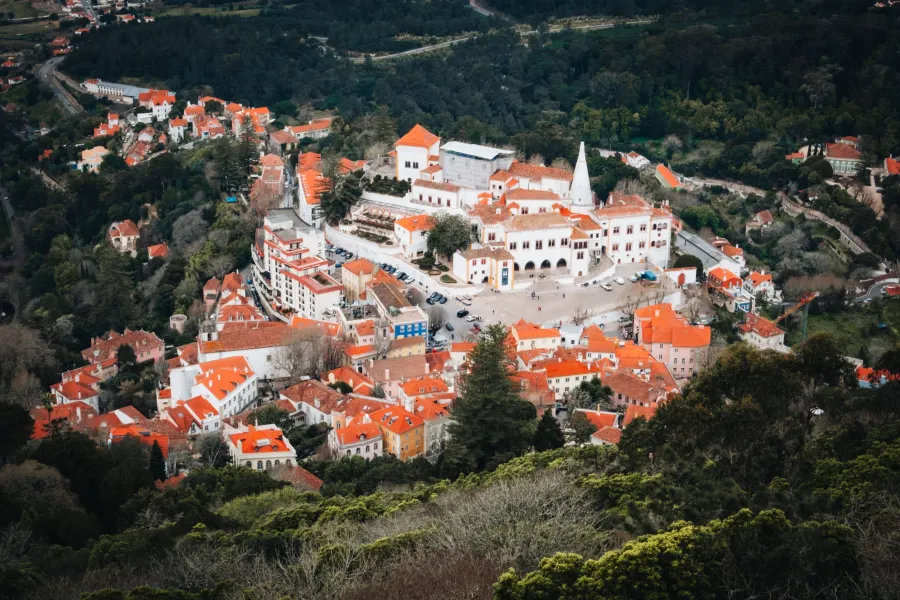
Sintra has been inhabited since prehistory and was fortified by the Moors, who built the hilltop castle that still crowns the ridge. After the Christian conquest in the twelfth century, Portuguese kings turned the valley into a summer retreat, and the National Palace with its twin conical chimneys became the favourite residence of the medieval court.
In the nineteenth century, Romanticism transformed the hills. King Ferdinand II rebuilt a ruined monastery into the colourful Pena Palace and planted an exotic forest around it; Portuguese and foreign aristocrats followed with their own estates, among them the esoteric gardens of Quinta da Regaleira and the palace of Monserrate. Lord Byron called it a "glorious Eden", and in 1995 UNESCO classified the whole cultural landscape as World Heritage.
What Sintra offers
- Palaces and estates: Pena, the National Palace, Monserrate, Quinta da Regaleira and Seteais, all within a few kilometres.
- A walled Moorish castle: ramparts along the ridge with views over the forest, the coast and, on clear days, Lisbon.
- Forests and gardens: the Parque da Pena, Parque da Liberdade and the wooded trails of the Sintra-Cascais Natural Park.
- A wild coastline: Praia da Adraga, Praia Grande, Praia das Maçãs and Cabo da Roca, all inside the same natural park.
- Local pastries: the traditional travesseiros and queijadas de Sintra, best eaten warm in the old town.
The people of the town
Beyond the postcard hills, Sintra is one of the largest municipalities in Portugal and a real working town. The historic centre lives on tourism, but the surrounding parishes are home to families commuting to Lisbon, to farms and vineyards in the Colares wine region, and to a long-established international community drawn by the microclimate and the green setting.
The old town is busiest between late morning and mid-afternoon; by early evening it returns to the residents, and the restaurants around the National Palace become noticeably calmer. The usual residential courtesies apply on the narrow streets, where cars, buses and pedestrians share very little space.
[nome de imagem: sintra-quinta-da-regaleira-gardens]
Main points of interest
- Palácio Nacional da Pena: the romantic hilltop palace and its exotic park, the image most associated with Sintra.
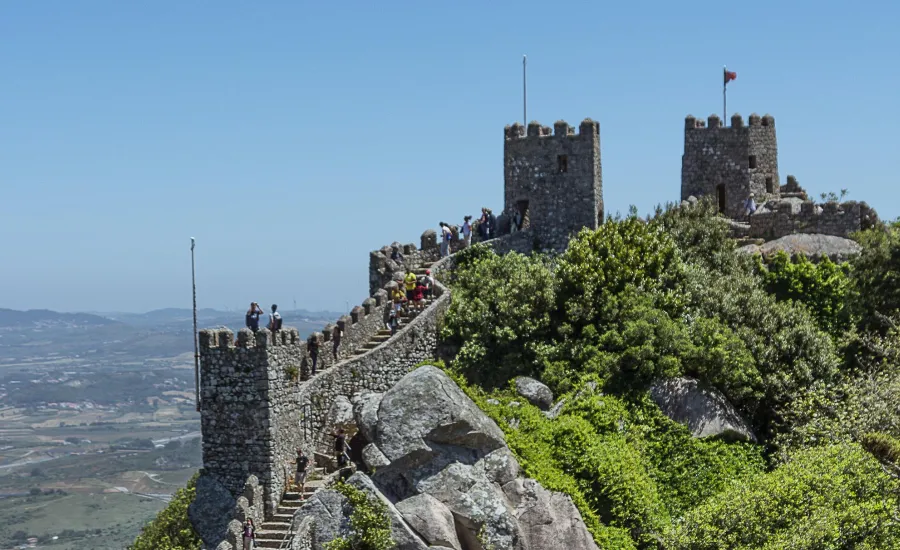
- Castelo dos Mouros: the tenth-century Moorish castle with walkable ramparts above the valley.
- Palácio Nacional de Sintra: the medieval royal palace in the centre, with its twin chimneys and tiled halls.
- Parque e Palácio de Monserrate: a romantic palace with one of the finest botanical parks in the country.
- Convento dos Capuchos: a tiny cork-lined monastery hidden in the forest, unusually atmospheric.
- Cabo da Roca: the westernmost point of mainland Europe, cliffs and lighthouse, about 20 minutes from the centre.
- Colares: the historic wine region between the hills and the sea, with small producers and village restaurants.
Suggested plan from our homes
- From the Cascais villa or the Estoril duplex, drive up through the natural park and arrive before 10:00; from Bairro Alto, take the train from Rossio.
- Start at Pena Palace with a pre-booked morning ticket, before the coaches arrive.
- Walk down to the Castelo dos Mouros and follow the ramparts for the views over the coast.
- Have lunch in the historic centre and try a travesseiro or a queijada.
- Spend the afternoon at Quinta da Regaleira or Monserrate, depending on whether you prefer symbolism or botany.
- Drive back along the coast through Colares, stopping at Cabo da Roca or Praia da Adraga for sunset before dinner at the villa.
If you are staying on the coast, the return through the natural park is part of the experience: from Cascais the drive is about 20 minutes, from Estoril around 25, and the roads are quiet in the late afternoon.
Good to know before you go
- Trains leave Rossio for Sintra every 20 to 30 minutes and take about 40 minutes. A Viva Viagem card covers the journey.
- Book palace tickets online with a time slot. Pena in particular sells out in high season and entry is by scheduled time.
- Driving into the historic centre is difficult: the streets are narrow, one way and often congested. Park below the centre or use the 434 and 435 bus loops.
- Sintra is cooler and much wetter than Lisbon, with frequent mist on the hills; bring a layer and comfortable shoes even in summer.
- Distances inside the park are steep. Allow walking time between the castle and Pena, or take the shuttle bus.
- Two palaces in one day is a comfortable pace; three is rushed. Mornings and late afternoons are the calmest hours.
- Sintra and Cascais are best kept as separate days; Sintra and the Atlantic coast at Cabo da Roca combine naturally.
Frequently asked questions
How do I get from Lisbon to Sintra?
Take the train from Rossio station to Sintra, about 40 minutes, with departures every 20 to 30 minutes. By car it is roughly 35 minutes from central Lisbon, 20 minutes from Cascais and 25 minutes from Estoril.
How many days do I need for Sintra?
One full day is enough for two palaces and the historic centre. Two days let you add Monserrate, the Convento dos Capuchos and the Atlantic beaches at a relaxed pace.
Which palace should I visit if I only have time for one?
Pena Palace, for the architecture, the park and the views. If you prefer gardens and atmosphere over crowds, Quinta da Regaleira or Monserrate are quieter alternatives.
Is it better to visit Sintra by train or by car?
By train from Lisbon, because parking in the centre is very limited. By car from our homes in Cascais or Estoril, because the drive through the natural park is short, scenic and lets you finish the day at Cabo da Roca or on the coast.